

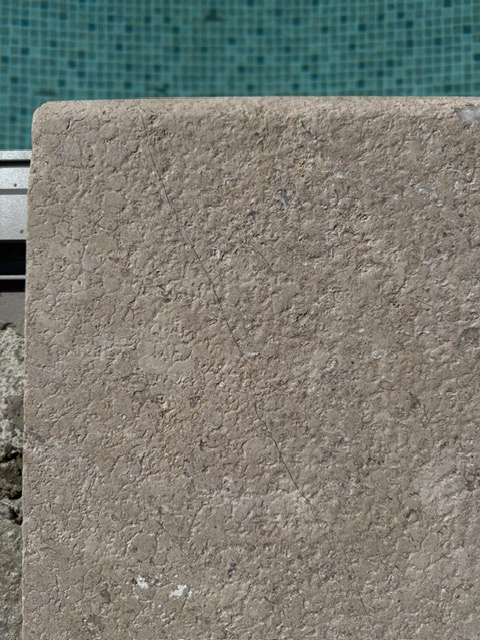
When you plan to build a brand new terrace, you’re excited and possibly a little anxious about anything not going well. You picture your beautiful slabs arriving to help you create an outdoor living space built to host decades of summer barbecues and peaceful morning coffees. Then, as the freshly unboxed slabs sit ready for installation, you notice a thin, jagged, contrast-colored line running right across the surface of a tile. The immediate reaction is almost always alarm. Is this tile cracked? Has it been broken and glued back together at the quarry? Is it going to snap the first time someone steps on it or during a hard winter freeze?
If you’ve ever had these thoughts—or if you’re trying to reassure a client of yours who has—take a deep breath. Those lines are not defects, cracks, or crude repair jobs.
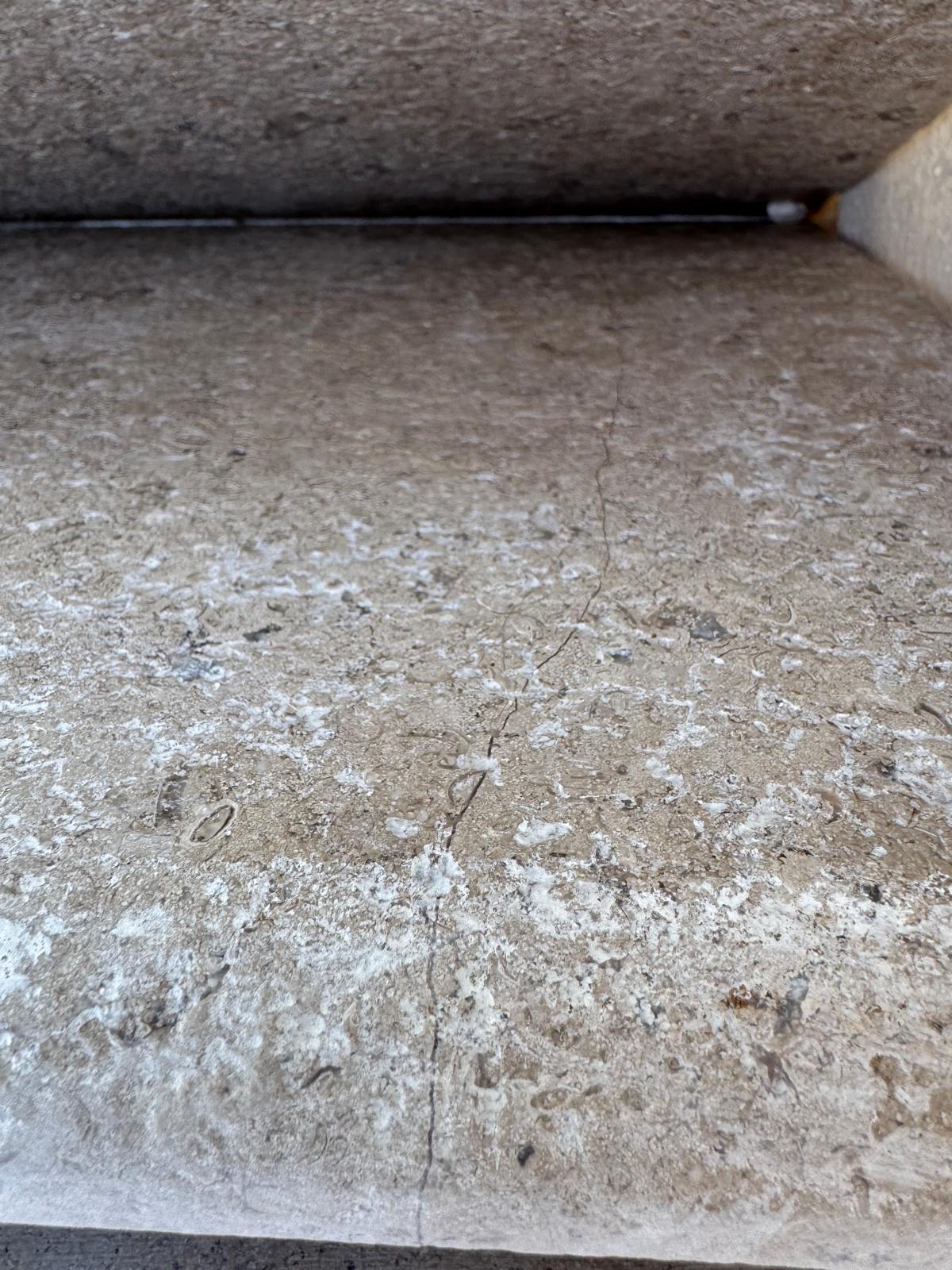
They are natural fissure lines or calcite veins, and far from being a sign of structural failure, they are the literal geological fingerprint of authentic natural stone. In this guide, we’re going to dive into the science of how limestone forms, why these unique lines appear, how to tell them apart from genuine damage, and why they are particularly prominent (and beautiful) in our premium limestone sourced from India and Egypt.
What Exactly Is a Fissure Line or Calcite Vein?
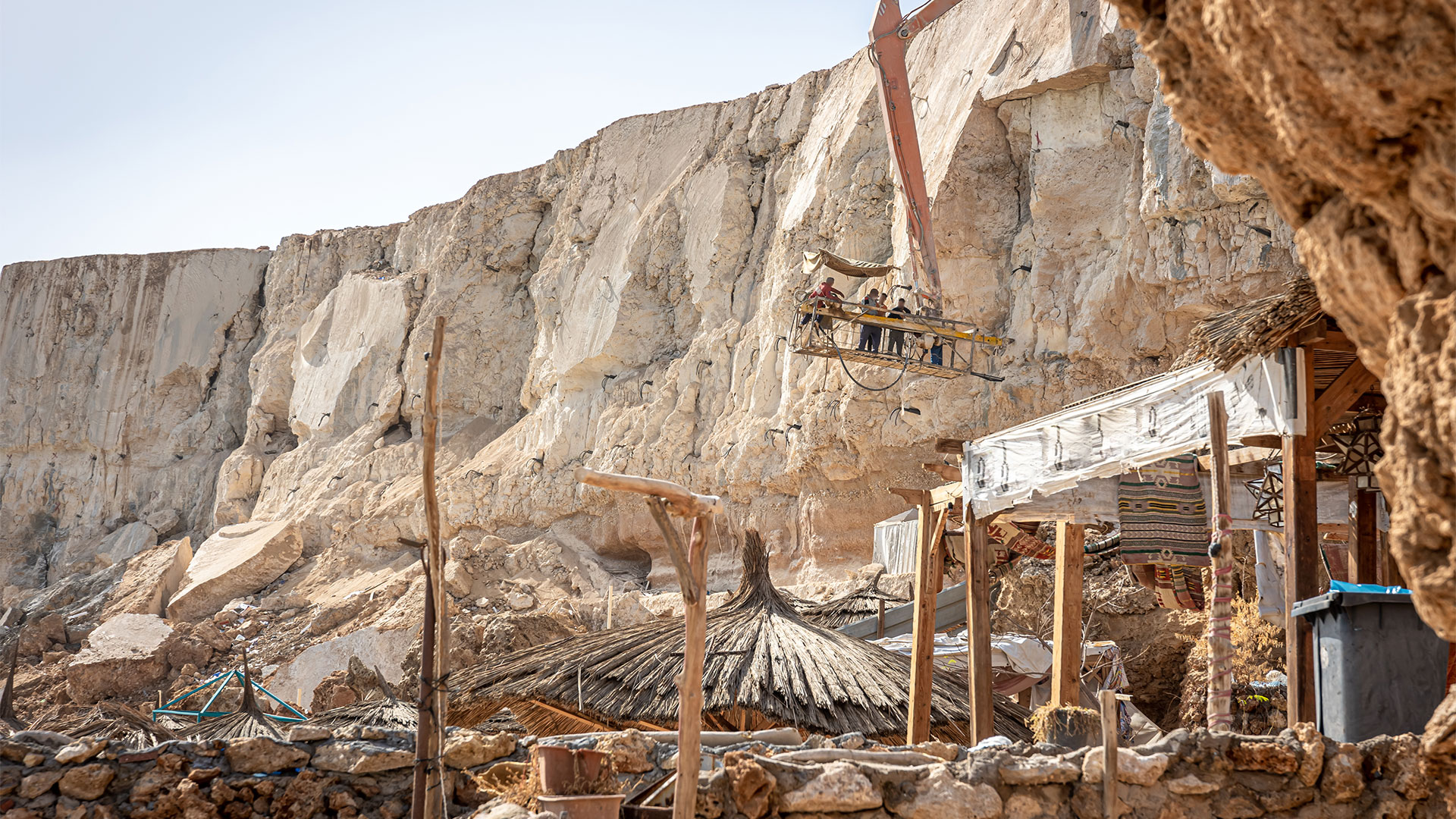
To understand why fissure lines exist, you have to go back millions of years. Limestone is a sedimentary rock formed predominantly on the floors of ancient seas and lakes. Over thousands of centuries, layers of organic material—shells, coral, micro-skeletons, and calcium-rich sediment—accumulated and compacted under immense aquatic pressure.
During this intense geological pressure cooker, the Earth was constantly shifting. Tectonic movement, subterranean water flow, and massive thermal stress caused micro-fractures to form within the deep mineral deposits.
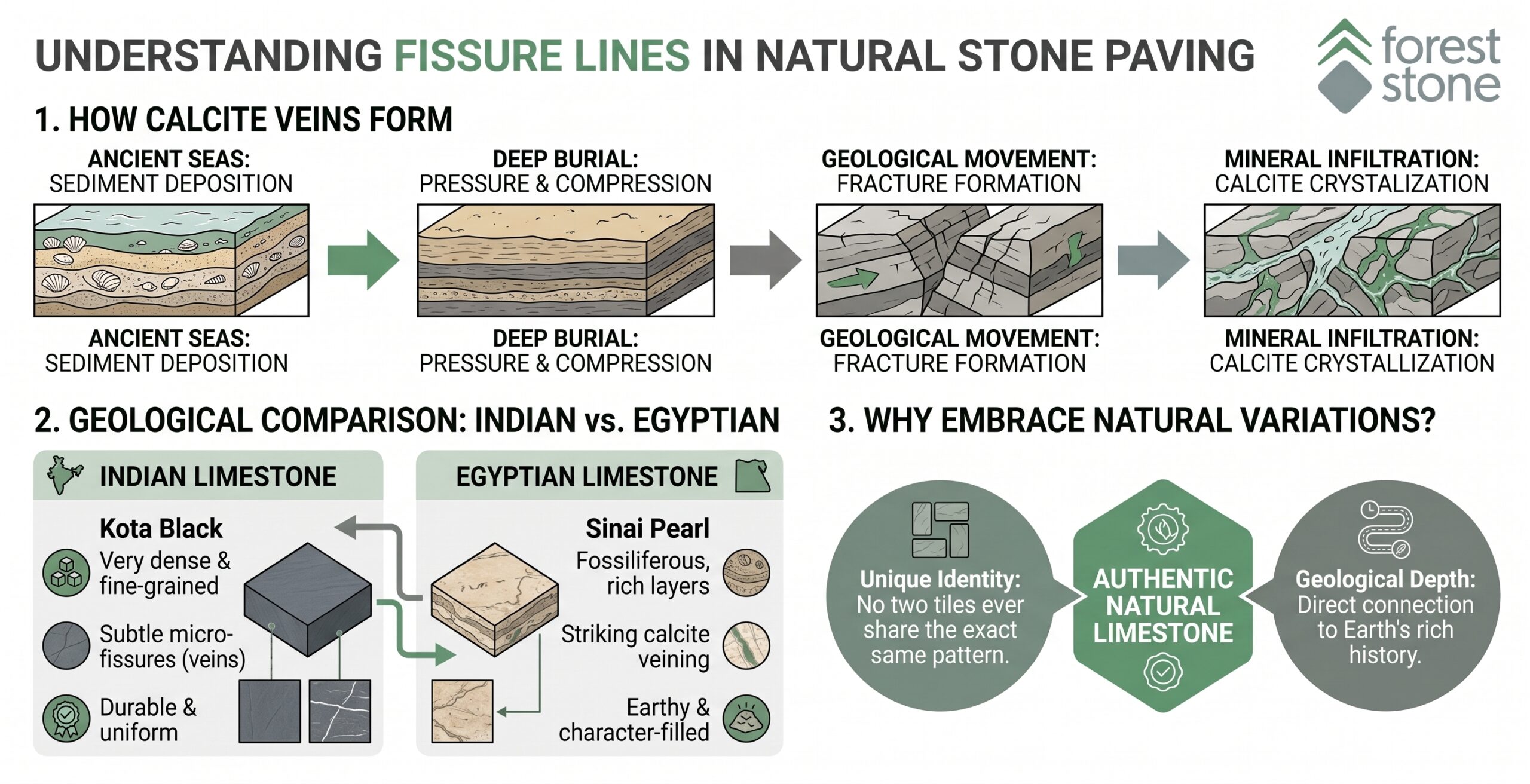
                                  HOW CALCITE VEINS FORM
                                  ======================

  Phase 1: Deep Compression          Phase 2: Micro-Fracturing          Phase 3: Mineral Crystallization
  -------------------------          -------------------------          --------------------------------
    ~~~~~~~~~~~~~~~~~~~~~~~            ~~~~~~~~~~~~~~~~~~~~~~~            ~~~~~~~~~~~~~~~~~~~~~~~
    Organic Sediments & Shells         Tectonic Movement Creates          Mineral-Rich Groundwater Flows
    Compacted Under Deep Sea           Microscopic Fissures in            Through & Crystallizes Pure
    Pressure Over Millennia            The Solidifying Stone              Calcite into Solid Veins
    ~~~~~~~~~~~~~~~~~~~~~~~            ~~~~~~~~~~~~~~~~~~~~~~~            ~~~~~~~~~~~~~~~~~~~~~~~
               │                                  │                                  │
               ▼                                  ▼                                  ▼
   ┌──────────────────────┐           ┌──────────────────────┐           ┌──────────────────────┐
   │ Solidifying Bedrock  │           │   Micro-Fracture     │           │   Fused Mineral Line │
   └──────────────────────┘           └──────────────────────┘           └──────────────────────┘
As water rich in dissolved minerals (primarily calcium carbonate) trickled through these tiny subterranean fissures, those minerals began to precipitate and crystallize out of solution. Over time, the open micro-gaps were completely backfilled and locked solid by dense calcite crystals.
What you are looking at on the surface of your paving slab is not a fracture—it is a naturally mineralized seam. The stone was open millions of years ago, but the Earth welded it shut with pure mineral long before humans ever quarried it.
Cracks vs. Fissure Lines: How to Tell the Difference
It is completely understandable why homeowners confuse fissure lines with cracks. To the untrained eye, any continuous thin line across a stone surface looks suspicious. However, identifying which is which is straightforward once you know what to look and feel for.
| Feature | Natural Fissure Line / Calcite Vein | Structural Crack |
| Surface Texture | Smooth and flush with the tile face. Doesn’t catch a fingernail. | Jagged, recessed, or rough edges along the fracture line. |
| Light Transparency | Often translucent, milky white, glassy, or subtly darker/lighter. | Opaque, dark gap where dirt collects; no light transmission. |
| Structural Integrity | Solid rock; density across the vein is equal to or higher than surrounding stone. | Flexes or separates when pressure is applied across the fault line. |
| Pattern | Natural, curving, organic movement following sedimentary grain. | Sharp, straight, or jagged breaks; often originates from an edge or impact point. |
| Depth & Backing | Visible on surface and revers side sometimes but the line is the same width front and back. | Runs completely through the slab, can often be wider on one side. |
The Fingernail Test
Run your fingernail flat across the line.
-
If your nail glides smoothly over the line without snagging: You are touching a fully fused calcite vein or closed natural fissure line. It is part of the solid stone matrix.
-
If your nail drops into a distinct groove or catches a sharp edge: You may be looking at a surface scratch or a real hairline fracture caused by transport or handling.
The Hand Mallet Test
Many landscapers worry that they’ll spend time laying one of these tiles with a calcite vein in only for it to crack while they are tapping the slab down with a rubber mallet. To ward against this issue you can test the suspected ‘crack’ with your hands. Make your hand into a fist, sit the slab on its end so you can see the front and back of it. With one hand hold the slab steady so it doesn’t fall to the ground, with the other hit the tile with the base of your fist using medium pressure around the area of the fissure line/vein. If it’s a fissure or calcite the tile will remain intact. If it’s a crack it will likely fall apart.
The “Glued Together” Myth
One of the most common calls we get from clients goes something like this: “It looks like two pieces of stone broke in the factory and someone glued them back together.”
It’s easy to see why people think this, especially when looking at bright white or crystal-clear calcite lines running through dark or warm-toned limestone. Or dark calcite lines running through our Lymington range of tiles. But stone factories do not painstakingly glue split paving slabs back together. The labor alone would cost far more than cutting a fresh piece of raw block!
That “glue line” is 100% natural, solid calcium carbonate—the same raw material limestone is made of, just crystallized in a pure, dense state.
Limestone Sourcing: A Tale of Two Core Countries
At Forest Stone, our natural limestone paving is primarily sourced from two of the world’s finest stone-producing regions: India and Egypt. While both produce world-class paving materials capable of enduring harsh outdoor climates, their geological origins give them distinctly different fissure characteristics.
                                GEOLOGICAL COMPARISON
                                =====================

           INDIAN LIMESTONE                              EGYPTIAN LIMESTONE
        (e.g., Winsor, Blissford)                    (e.g., Sinai Pearl, Lymington)
       ──────────────────────────                   ────────────────────────────
        • Fine-grained, dense structure             • Fossiliferous, rich sedimentary base
        • Subtle micro-fissures                     • Striking white & dark calcite veins
        • High-contrast tones.                      • Earthy, warm, sun-baked tones
        • Sedimentary bedding planes                • Deep marine shell inclusions
1. Indian Limestone (e.g., Winsor Black, Portmore, Blissford Limestone)
Indian limestone is renowned for its uniform texture, low porosity, and clean modern aesthetic. Formed in ancient inland basins across the Indian subcontinent, these stones are exceptionally dense and fine-grained.
-
Fissure Characteristics: Fissures in Indian limestone tend to present as fine, delicate threads or subtle tonal shifts that follow the natural bedding planes of the stone.
-
Winsor Limestone: In darker stones like our Winsor, you may occasionally spot thin, pale gray micro-fissures or mineral veining. When the stone is split along its natural layers (riven), these lines simply show where ancient micro-shifts occurred.
- Blissford Limestone: In lighter coloured stones like our Blissford, Wilverley and Portmore these lines often present themselves as feint graphite grey veins that can look like pencil marks and occasionally similar shaped lines that are orange or sandy in colour.
-
Durability: Because Indian limestone is so dense, these internal veins are tightly compacted. They pose no threat to the freeze-thaw performance of your patio when laid correctly on a full mortar bed.
2. Egyptian Limestone (e.g., Sinai Pearl, Egyptian Beige, Lymington Dune)
Egyptian limestone is world-famous for its luxurious, sun-warmed aesthetic. Mined from historic quarries that supplied building materials for ancient monuments, this stone formed in warm, shell-rich shallow marine environments.
-
Fissure Characteristics: Egyptian limestone is rich in calcite veins, fossil inclusions, and bold mineral banding. You will often see bright white, cream, or translucent glassy/oily streaks running diagonally across beige or gold background tones.
-
Why They Stand Out: The contrast between the soft beige matrix and the hard, crystalline calcite line can be quite striking. Some slabs will have short, zig-zagging veins, while others have sweeping calcite ribbons running edge-to-edge.
-
Natural Character: In Egyptian stone, these lines aren’t just common—they are essential to the stone’s beauty. Without calcite veining and fossilized ocean life, Egyptian limestone would lose the rich visual texture that makes it so popular for indoor-outdoor living spaces.
Structural Integrity: Do Fissures Make the Slab Weaker?
The short answer is: No, a fused calcite line or closed natural fissure line does not make the slab weaker.
In many cases, pure calcite veins are actually harder than the surrounding limestone matrix. When stone density is measured in laboratory testing, calcite crystals score higher on the Mohs hardness scale than the softer sedimentary rock around them.
However, there is an important nuance to understand regarding how natural stone is handled during installation.
Handling and Installation: What You Need to Know
While a calcite vein is fully fused inside a complete, laid paving slab, natural fissure lines represent points of historical geological movement. During transport, cutting, or installation, raw stone is subjected to forces it never experienced underground.
Here is how to ensure your limestone paving stays in pristine condition from crate to patio:
1. Handle Slabs on Edge
Uninstalled tiles are most vulnerable when carried flat, especially large-format slabs. Carrying a slab flat puts flexural tension on the middle of the tile. Always lift and carry natural stone slabs vertically on their edge to prevent accidental cracking along natural grain boundaries.
2. Mind the Tapping-Down Process
During installation, lay slabs onto a full wet mortar bed and use a rubber mallet to adjust the level.
When tapping down, you do not need to hit the tile hard. Care should be taken, especially with limestone, not to hit natural fissure lines directly or excessively hard with a rubber mallet.
Reasonable, distributed tapping encourages full contact with the mortar bed without shocking the natural veins of the stone. This is especially important if you have been used to laying something like porcelain paving or sandstone which is less dense and bends more than limestone.
3. Full Mortar Bedding is Mandatory
Never lay limestone on “dots and dabs” or spot-bedding. Spot-bedding leaves hollow air pockets under the slab. If a heavy weight (like a patio table leg or garden planter) sits over a hollow space directly above a natural vein line, the slab can flex and crack. Laying slabs on a continuous, 100% full mortar bed supports every square inch of the stone, rendering natural fissure lines completely immune to surface weight load.
Embracing the Art of Natural Stone
If you wanted a patio where every single tile looked identical, you would choose mass-produced porcelain or concrete. But you didn’t—you chose natural limestone.
When you install genuine stone, you are buying a slice of geological history. No two slabs in a crate will ever look identical. One tile may feature a soft, uniform grain; another may showcase dramatic mineral shading; a third will display a prominent white calcite vein tracing a path laid down millions of years ago.
                      WHY EMBRACE NATURAL VARIATIONS?
                      ===============================

     ┌───────────────────┐                 ┌───────────────────┐
     │  Unique Identity  │                 │ Geological Depth  │
     │ No two tiles ever │                 │ Direct connection │
     │ share the exact   │                 │ to Earth's rich   │
     │  same pattern.    │                 │ history.          │
     └─────────┬─────────┘                 └─────────┬─────────┘
               │                                     │
               └──────────────────┬──────────────────┘
                                  │
                                  ▼
                   ┌─────────────────────────────┐
                   │ Authentic Natural Limestone │
                   └─────────────────────────────┘
These features aren’t imperfections—they are proof of authenticity. They give your garden patio character, depth, and organic warmth that factory-made alternatives cannot match.
Quick Reference Summary for Homeowners and Installers
-
Fissure lines and calcite veins are natural, mineral-filled features formed millions of years ago during the stone’s compaction under the sea.
-
They are not cracks, defects, or glue repairs. They are fully fused, solid calcium carbonate built directly into the structure of the stone.
-
They are prominent in both Indian and Egyptian limestone, showcasing white mineral streaks, fossil beds, and delicate grain lines.
-
They will not compromise the life of your patio when the stone is laid properly on a full 100% wet mortar bed.
-
Perform the fingernail test: If the line is smooth to the touch, it is a closed, natural feature ready to be laid and enjoyed for years to come.
By understanding the story written inside your paving slabs, you can watch your garden space come together with complete confidence—knowing that those striking lines are just nature’s way of signing its artwork.